scrub_date
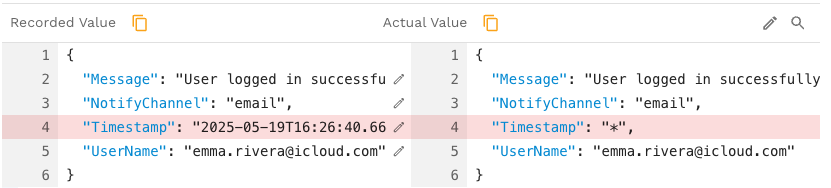
The scrub_date transform walks a JSON body and replaces every value that looks like a date or datetime with *. It is the date-aware sibling of scrub — instead of scrubbing a specific extracted value, it scrubs every date-shaped field in the body. This neutralizes the dynamic-timestamp problem that otherwise breaks responder signature matching for requests that carry now()-style fields.
- Transform type name (config/API):
scrub_date - Shorthand format:
scrub_date(ignore=...)
Quick Start
"type": "scrub_date",
"config": {}
req_body() → scrub_date()
Every date-shaped string in the JSON request body becomes *. No further configuration is needed for the common case.
How It Works
scrub_date runs entirely in the first phase. The second phase is a no-op.
-
First phase — the token entering the transform is assumed to be JSON. The DLP engine walks every key/value in the JSON, including nested objects and arrays. For each string value, the engine asks two questions:
- Does the value match the
datetimeDLP pattern (a recognized date or timestamp shape)? - Does the value parse as a valid datetime by Speedscale's lenient date parser?
If either is true and the field's leaf key is not in
ignorePaths, the value is replaced with*. The walk continues into nested structures. - Does the value match the
-
Second phase — no-op. The scrubbed JSON returned by the first phase is what subsequent transforms in the chain see.
What Counts as a Date
The transform recognises a broad spectrum of formats — ISO 8601 (2023-10-01T12:00:00Z), RFC 1123 (Mon, 02 Jan 2006 15:04:05 MST), date-only (2023-10-01), and many others. The recognition is the same one that powers layout=auto in the date transform.
Numeric values are not scrubbed. A Unix epoch number like 1696156800 is left alone because the walk is restricted to JSON string scalars. If you need to neutralize epoch timestamps, use the date transform on that field with layout=epoch, or convert the field to a string before scrubbing.
Scope
scrub_date operates on whatever the chain hands it. The token is expected to be a JSON document or fragment.
req_body() → scrub_date()scrubs the entire request body.res_body() → scrub_date()scrubs the entire response body.res_body() → json_path(path="event") → scrub_date()scrubs only the JSON subtree rooted atevent.
If the token isn't valid JSON, the walk produces no changes and the value passes through.
Configuration
"type": "scrub_date",
"config": {
    "ignorePaths": "<comma-separated key names>"
}
| Parameter | Required | Default | Description |
|---|---|---|---|
ignorePaths | No | empty | Comma-separated list of JSON key names to leave alone. Matched against the last key in the path only — "createdAt" skips every field named createdAt at any depth. |
ignorePaths Matching
Just like scrub, only the leaf key name is compared. You cannot pass a dotted path. Given {"user": {"profile": {"birthDate": "..."}}}, ignorePaths=birthDate skips the field; ignorePaths=profile.birthDate matches nothing.
Examples
Example 1 — Scrub all dates in a request body
{
    "type": "scrub_date",
    "config": {}
}
req_body() → scrub_date()
Before:
{
    "orderId": "12345",
    "timestamp": "2021-04-19T10:30:00Z",
    "user": {
        "createdAt": "2021-01-15T08:00:00Z",
        "lastLogin": "2021-04-19T09:15:30Z"
    }
}
After:
{
    "orderId": "12345",
    "timestamp": "*",
    "user": {
        "createdAt": "*",
        "lastLogin": "*"
    }
}
Example 2 — Preserve a known-stable field
{
    "type": "scrub_date",
    "config": {
        "ignorePaths": "version,createdBy"
    }
}
res_body() → scrub_date(ignorePaths="version,createdBy")
Useful when one of the date-shaped fields is a deliberate, stable value (e.g. an API spec version date or a created-by audit field) that should remain untouched.
Example 3 — Scrub a nested subtree only
res_body() → json_path(path="audit") → scrub_date()
Only the JSON subtree under audit is walked; everything else in the response body is unaffected.
Example 4 — Epoch numbers are not scrubbed
Before: {"event": {"date": 1696156800}}
After: {"event": {"date": 1696156800}}
Numeric fields pass through. If you need to neutralize this, switch to date with layout=epoch on that field, or convert the field to a string upstream.
Common Misconceptions
-
"It modifies dates in headers or the URL." No. The walk is JSON-only. Headers, URL path, and query strings are not touched.
-
"Epoch timestamps in numeric fields get scrubbed." No. Only JSON string scalars are inspected. Numbers are skipped.
-
"
ignorePathstakes a JSONPath." No. Only the last key name is compared. Use leaf names likecreatedAt, not paths likeuser.createdAt. -
"It shifts dates relative to replay time." No — that's the
datetransform.scrub_dateonly neutralizes dates to*. Usedatewhen you need replay-relative timestamps; usescrub_datewhen you want the field gone from signature matching entirely. -
"It only scrubs fields whose key looks date-shaped." No. The decision is made on the value's shape, not the key's name. A field called
notewhose value happens to be"2023-10-01"will be scrubbed.
Troubleshooting
| Symptom | Likely cause | Fix |
|---|---|---|
| Body unchanged after the transform | Body is not valid JSON, or no string values match a known date format | Confirm the body is JSON; inspect the values that should have been scrubbed |
| A numeric epoch wasn't scrubbed | Walk only inspects strings | Switch to date with layout=epoch, or stringify the field upstream |
| A field that wasn't a date got scrubbed | The value happened to match a date format (e.g. "2023-01-01" as a version string) | Add the field's key to ignorePaths |
ignorePaths not respected | Used a dotted path | Use the leaf key name only |
| Only part of the response body was scrubbed | Chain extracted a subtree via json_path | Remove the json_path step to scrub the whole body |
Related Transforms
scrub— substring-scrub of a specific extracted value across the body. Use when you have one rotating value to blank out; usescrub_datewhen you want to blank out all date-shaped values.date— shifts dates relative to replay time instead of erasing them. Use when the SUT needs to see plausible timestamps.dlp_json— walks the JSON the same way but applies DLP redaction (PII categories) instead of date neutralization.
Advanced Notes
- The walk uses the same JSON traversal as
dlp_json, including correct handling of root-array bodies and nested arrays. A body whose root is[{"createdAt": "..."}]is scrubbed correctly. - Date detection combines DLP pattern recognition with Speedscale's lenient date parser, so values that don't trip the pattern but still parse cleanly as a datetime are also caught.
- The transform does not require the recorded response to be present in the action file.
- Errors during the JSON walk are non-fatal; the transform returns the input unchanged if the body cannot be parsed.